AVN Surgery Recovery Time: What to Expect After Core Decompression or Hip Replacement Surgery in Chandigarh
Quick answer: AVN surgery recovery time depends mostly on which operation you have. Hip preserving surgery such as core decompression usually means a period of protected walking on crutches, often several weeks, while a total hip replacement for a collapsed hip usually gets you walking with support within a day or two and back to most daily routines over the following weeks to months. Your surgeon will set your exact timeline after looking at your stage, X-rays and MRI. For patients considering Hip Replacement Surgery in Chandigarh, understanding the recovery process can help set realistic expectations.
“Doctor, I have a cousin’s wedding in Ludhiana in February. Will I be dancing by then?”
Picture a man in his late thirties from Sector 70, Mohali, MRI report in hand, just told he has avascular necrosis (AVN) in his left hip. We hear some version of his question in clinic every few weeks. He is less worried about the diagnosis than about time. How long off work? When can he drive to Kharar to see his parents?
These are fair questions. And honestly, the answer changes a lot depending on the surgery.
Why does AVN recovery time vary so much?
AVN means part of the ball of the hip joint has lost its blood supply. The bone weakens and, if things progress, the round surface can flatten or collapse. You can read the background in our article on avascular necrosis of the hip.
The stage at diagnosis decides the operation. The operation decides the recovery.
In early stages, before the head of the femur has collapsed, surgeons often try to save the patient’s own hip. Once collapse and arthritis have set in, replacing the joint is usually the more reliable option. Those two paths have very different recovery curves, so online answers often compare apples and oranges.
What is recovery like after core decompression?
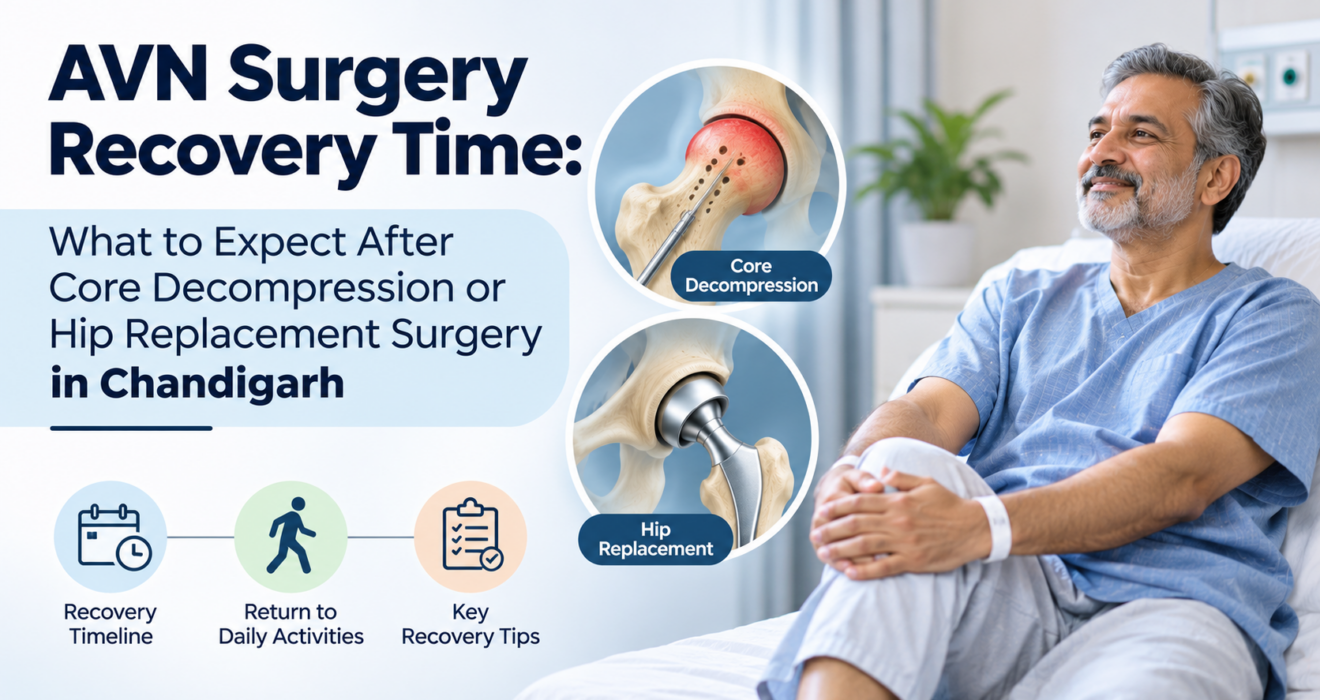
Core decompression is a hip preserving procedure. The surgeon drills a small channel into the dead area of bone to reduce pressure inside it and encourage healing. Sometimes bone graft is added.
The surgery itself is short. The catch is what comes after.
Because the treated bone is weak for a while, most patients are asked to keep weight off that leg, or put only partial weight on it, using crutches or a walker. Many surgeons keep this protected phase going for several weeks, and some keep it longer, depending on how the hip looks on follow up X-rays. Running, jumping and weekend cricket usually wait a few months.
What we tell younger patients from Mohali and Zirakpur is simple. The pain from the operation settles quickly. The discipline of staying on crutches is the hard part. People feel fine and start walking normally too early, and that is exactly when a weak femoral head can give way.
Desk jobs often resume sooner than physical ones, but that is your surgeon’s call.
What is recovery like after hip replacement for AVN?
If the femoral head has already collapsed, total hip replacement is often recommended. Here the dead bone and damaged joint surfaces are removed and replaced with an artificial joint, so there is no weak bone left that needs protecting in the same way. Patients considering Hip Replacement Surgery in Chandigarh should discuss their recovery expectations and rehabilitation plan with their orthopaedic surgeon. Hip Replacement Surgery in Mohali is also an option for patients seeking specialised hip care in the region.
That changes the early weeks a lot. Most patients stand and take a few steps with a walker within a day or so of surgery, under the physiotherapist’s eye. A typical pattern looks something like this:
-
First few days: walking with a walker, learning safe ways to sit, stand and use the toilet.
-
First few weeks: moving from walker to stick, doing home exercises, slowly increasing walking distance.
-
Following months: gradual return to driving, office work, stairs, temple visits and longer walks, as advised at follow ups.
Age, diabetes, weight and fitness before surgery all play a part. Our realistic week-by-week hip replacement recovery timeline goes into more detail.
Is AVN in young people treated differently?
Often, yes. AVN commonly affects people in their thirties and forties, including those who have taken steroids for another illness or who drink heavily. Because younger patients have many decades ahead of them, surgeons tend to look hard at whether the hip can be saved when the disease is caught early.
But age alone should not keep someone in pain. When the joint has collapsed, delaying a replacement just to “wait till 60” may mean years of limping and poor sleep. We have written about this in hip replacement under 60.
What can you do at home to recover well?
A few things make a real difference, whichever surgery you have.
Set up your home before the operation. A firm chair with arms, a raised toilet seat or commode chair, and a clear path free of loose rugs. In many Punjabi homes the bathroom is a step down from the bedroom, and that one step causes more trouble than people expect.
Eat properly. Protein matters for healing: dal, paneer, eggs, curd, chicken if you eat it. Keep your sugar under control if you are diabetic.
Do the exercises. Every day. Even in the December fog when the last thing anyone wants is to get out of a warm razai.
And stop the things that may have contributed to AVN in the first place, if your doctor identifies them. Alcohol is a common one.
When should you call your surgeon?
Contact your surgical team quickly if you notice fever, increasing redness or discharge from the wound, calf pain or swelling, sudden severe hip pain, or a leg that suddenly looks shorter or turned. Do not wait for the next scheduled follow up in these situations.
Frequently Asked Questions
How long will I be on crutches after core decompression?
It varies. Many patients use crutches or a walker for several weeks, and the surgeon decides when to increase weight based on symptoms and follow up X-rays.
Can AVN come back after hip replacement?
The dead bone is removed during a replacement, so AVN does not return in that hip. AVN can affect the other hip, though, so tell your doctor about any new pain on the other side.
Does core decompression always save the hip?
No. It tends to work better in earlier stages. Some patients still progress and need a hip replacement later, which is why regular follow up matters.
When can I drive after AVN surgery?
This depends on which hip was operated, the type of car, your pain and your reaction time. Ask your surgeon at your follow up visit rather than guessing.
Is AVN surgery available in Mohali?
Yes. Dr. Zubin Mehta treats hip conditions including AVN and performs hip replacement at Fortis Hospital Mohali. Patients exploring Hip Replacement Surgery in Mohali can discuss their treatment options during a consultation. See our orthopaedic treatments page.
If you have been told you have AVN and want to understand your stage and options, you can book a consultation with Dr. Zubin Mehta here. If you are considering Hip Replacement Surgery in Chandigarh, a timely consultation can help you understand the most appropriate treatment and recovery plan.