
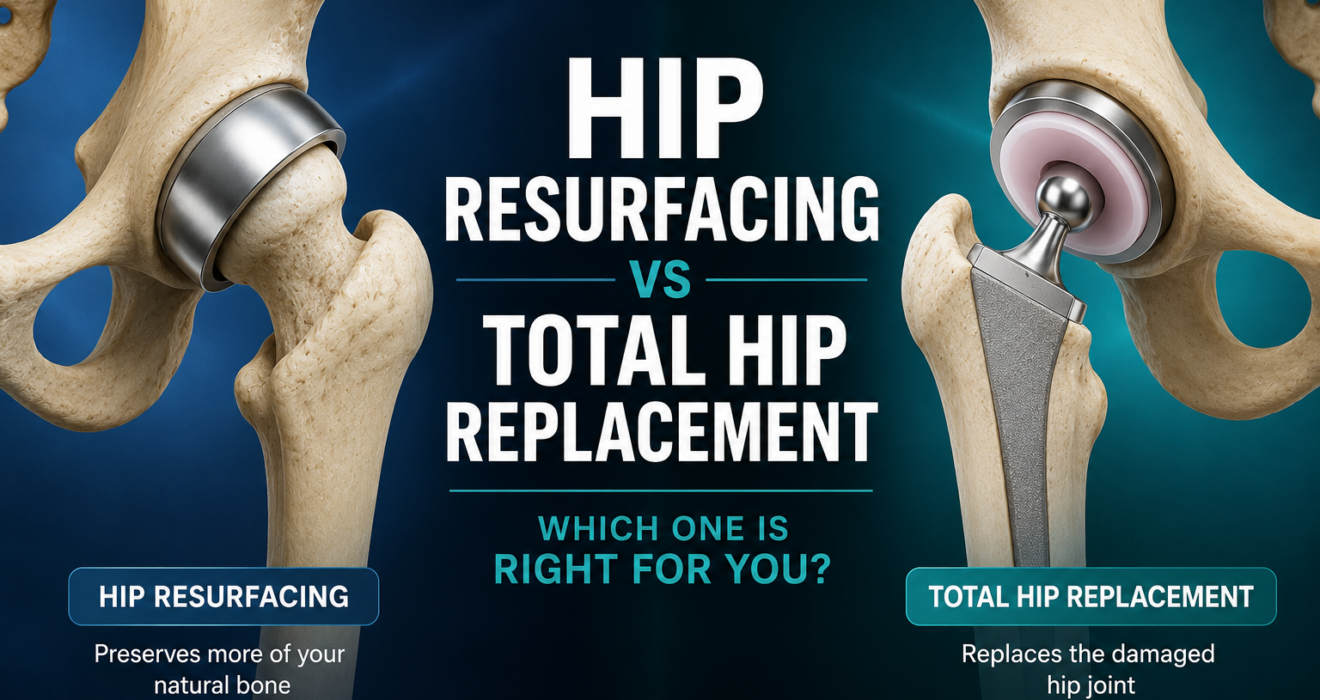
Hip Resurfacing vs Total Hip Replacement: Which One Is Right for You?
A few months ago, a 41-year-old marathon runner walked into my OPD with a printed research paper about hip resurfacing. He’d done his homework thoroughly—read the long-term data, understood the implant design, and even knew the specific bearing surfaces used in different resurfacing systems. His question was precise: “Am I a candidate?”
I appreciated the preparation. And the honest answer was possibly, but probably not. Here’s why—and when—the answer would be different.
What Hip Resurfacing Is
In total hip replacement, the entire femoral head — the ball part of the joint — is removed and replaced with a prosthetic metal stem and ball component. In hip resurfacing, the femoral head is not removed. Instead, the damaged cartilage surface is trimmed and reshaped, and a metal cap is placed over the reshaped femoral head. On the socket side, a metal cup is implanted as in standard hip replacement.
The bone-conserving element of resurfacing is its primary appeal. The original femoral head and neck remain largely intact, which theoretically preserves more bone for any future revision surgery. For young patients concerned about needing multiple surgeries over a lifetime, this is an intuitive advantage.
The Evidence Base for Resurfacing
Hip resurfacing has a real evidence base—it is not an experimental procedure. The Birmingham Hip Resurfacing (BHR) system, the most studied device, has 20-year data showing good survival rates in the right patient population. The key words there are “the right patient population.”
The patients who do well with resurfacing in the literature are consistently male, under 55, with a large femoral head size (which accommodates the larger resurfacing implant), good bone density, and minimal femoral head deformity. Large femoral head size effectively means larger-framed patients—this is one reason why the outcomes in female patients with resurfacing are historically inferior to males.
The Metal-on-Metal Problem
Hip resurfacing systems use metal-on-metal bearings—a cobalt-chrome alloy cap articulating against a cobalt-chrome socket. Wear of metal-on-metal surfaces releases cobalt and chromium ions into the surrounding tissue and bloodstream. In most patients with well-positioned implants, these levels are low and clinically insignificant. In patients with poorly positioned components or adverse reactions to metal particles, the results can be serious: pseudotumours, osteolysis, and adverse local tissue reaction (ALTR) that can require urgent revision surgery.
This is not a reason to universally condemn resurfacing—well-positioned implants in appropriate patients have a low rate of these complications. But it is a reason to be selective, to monitor patients annually with metal ion blood tests, and to have a low threshold for investigation if pain recurs.
Total Hip Replacement: Why It Remains My Default Recommendation
Total hip replacement with modern ceramic or highly cross-linked polyethylene bearings eliminates the metal ion concern entirely. The long-term survival data is extensive. The technique is reproducible in a wider range of patient anatomies. Female patients, patients with osteoporosis, patients with significant femoral head deformity, and patients with post-traumatic or AVN disease are all better served by total replacement than resurfacing.
The bone-conservation argument for resurfacing has also been partly addressed by modern total hip replacement design. Shorter-stemmed femoral components now preserve significantly more proximal femoral bone than traditional long-stem prostheses, reducing the advantage resurfacing holds on this dimension.
When I Would Consider Resurfacing
The case for resurfacing is strongest in a young male patient (ideally under 50), large femoral head size, good bone density, primary osteoarthritis or AVN without significant deformity, high activity expectations, and a strong personal preference for bone conservation after full informed discussion of the metal ion risk.
This is a narrow patient group. In my practice, it represents perhaps 5 to 10% of the young active patients I see. For the other 90 to 95%, total hip replacement with modern components is the right recommendation.
For the marathon runner who came with his research paper, he had a relatively small femoral head, post-traumatic hip dysplasia, and some lateral femoral head flattening from prior impact. I recommended total hip replacement with a ceramic bearing and a short stem. He was disappointed initially. After I explained the specific anatomy-based reasoning, he understood and agreed. At 10 months post-surgery, he ran a 10km event. Total hip replacement in Mohali. His hip is fine.
CTA: If you’re researching whether resurfacing or total hip replacement is right for your specific anatomy and age, come for a consultation. I’ll give you an honest, anatomy-based recommendation.
OPD: Tuesday and Thursday, Fortis Hospital Mohali. +91 79735 06344.