Life After Hip Replacement: What Activities Are You Actually Allowed to Do?
One of my patients — a 58-year-old retired district judge from Patiala — came to his three-month follow-up and asked, very carefully, whether he could resume his morning yoga practice.
I asked him to describe what the practice involved. He described a sequence that included forward folds, hip flexion beyond 90 degrees, and cross-legged seated positions. I gave him a modified answer: some of it yes, some of it not safely.
He looked relieved at the “some of it yes” part. And I realised that patients often arrive at post-operative appointments expecting a longer list of restrictions than actually exists. The reality is: life after hip replacement is largely unrestricted. The restrictions that do exist are specific and logical — not a general prohibition on physical activity.
What You Can Do: The Allowed List
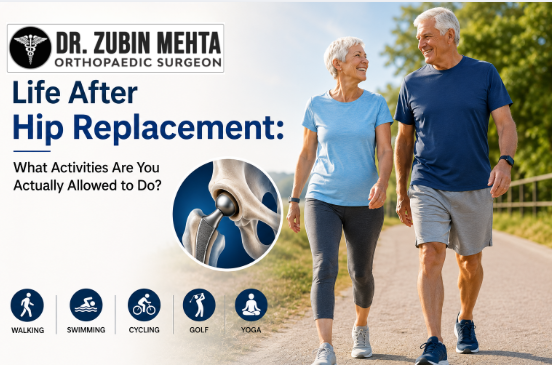
Walking. Unlimited. Walking is the best exercise you can do for your hip-replacement-chandigarh — and your cardiovascular health, your weight, and your mental health. Aim for 30 to 45 minutes daily once you’re fully recovered. No distance limit.
Swimming. Allowed from approximately 10 to 12 weeks — once the wound is fully healed. Swimming is excellent for hip replacement patients because it provides cardiovascular and muscle conditioning with zero impact. Breaststroke is the only style to approach carefully in the early months, as the frog-kick motion requires significant hip external rotation. Freestyle, backstroke, and kick-board drills are fine.
Cycling. Stationary cycling can begin as early as 6 weeks for gentle range-of-motion work. Road or path cycling at 3 to 4 months. No significant restriction thereafter.
Golf. Most patients return to golf at 4 to 6 months. I do advise patients to begin with half-swings and build gradually, and to avoid playing on steep or uneven terrain in the first few months.
Social dancing, light hiking, doubles tennis. All allowed by 6 months. Doubles tennis places less sudden lateral load than singles — the reduced court coverage is a natural load modifier.
Travel. Flying is safe from approximately 6 weeks with appropriate precautions: compression stockings, walking the aisle every 1 to 2 hours, and hydration. Long-haul international travel at 3 months is generally fine. Carry a card documenting your joint replacement for airport security.
Driving. Return to driving depends on which hip and which controls. Right hip surgery with a manual car: 8 to 10 weeks minimum, after confirmed emergency-stop control. Left hip with an automatic car: as early as 4 weeks for some patients. Always ask me specifically — this is assessed individually.
Activities That Need Care and Modification
Yoga and pilates. Partial return. Most standing and supine yoga poses are safe and beneficial. Hip flexion beyond 90 degrees, deep forward folds, and cross-legged seated positions are permanently restricted. A yoga teacher experienced with post-surgical modification can be genuinely helpful.
Gym exercise. Return to gym at 3 to 4 months is appropriate for most patients. What to do: treadmill at a walking pace, stationary bike, swimming, seated resistance machines for upper body and leg press. What to permanently avoid: deep squats, lunges with significant hip flexion, step-up with full range, and high-impact classes.
Intercourse. Safe from approximately 6 to 8 weeks, with position modifications for the first 3 to 6 months to avoid extreme hip flexion or rotation. I address this proactively in my post-operative counselling because patients are often reluctant to ask and it directly affects quality of life.
What to Genuinely Avoid — Permanently
Running and jogging. High-impact repetitive loading of the bearing surface accelerates wear. The data on running after hip replacement surgery shows significantly higher wear rates and earlier revision in runners compared to non-runners. I understand this is a difficult restriction for runners. It’s a real one.
Contact sports: football, volleyball, basketball, martial arts. The risk here is not just wear — it’s dislocation from unpredictable external forces. A tackle, a collision, or a sudden off-balance movement can dislocate a hip replacement.
Deep squatting and sitting cross-legged. Both positions require hip flexion well beyond 90 degrees. This is the most common mechanism of hip dislocation, particularly in the first year. I recommend permanent avoidance.
Indian-style squat toilets. I raise this specifically because it is relevant for most of my patients’ daily home life. The deep squat position required is one of the most reliable ways to dislocate a hip replacement. If Indian-style toilets are present in your home, they need to be supplemented with a raised western-style commode or a commode adaptor for the long term. This is a real, documented mechanism of dislocation in my patient population.
CTA: Questions about what you can and cannot do after hip replacement surgery? If you’re considering , that conversation belongs in a proper follow-up appointment. OPD: Tuesday and Thursday, Fortis Hospital Mohali. Call +91 79735 06344.