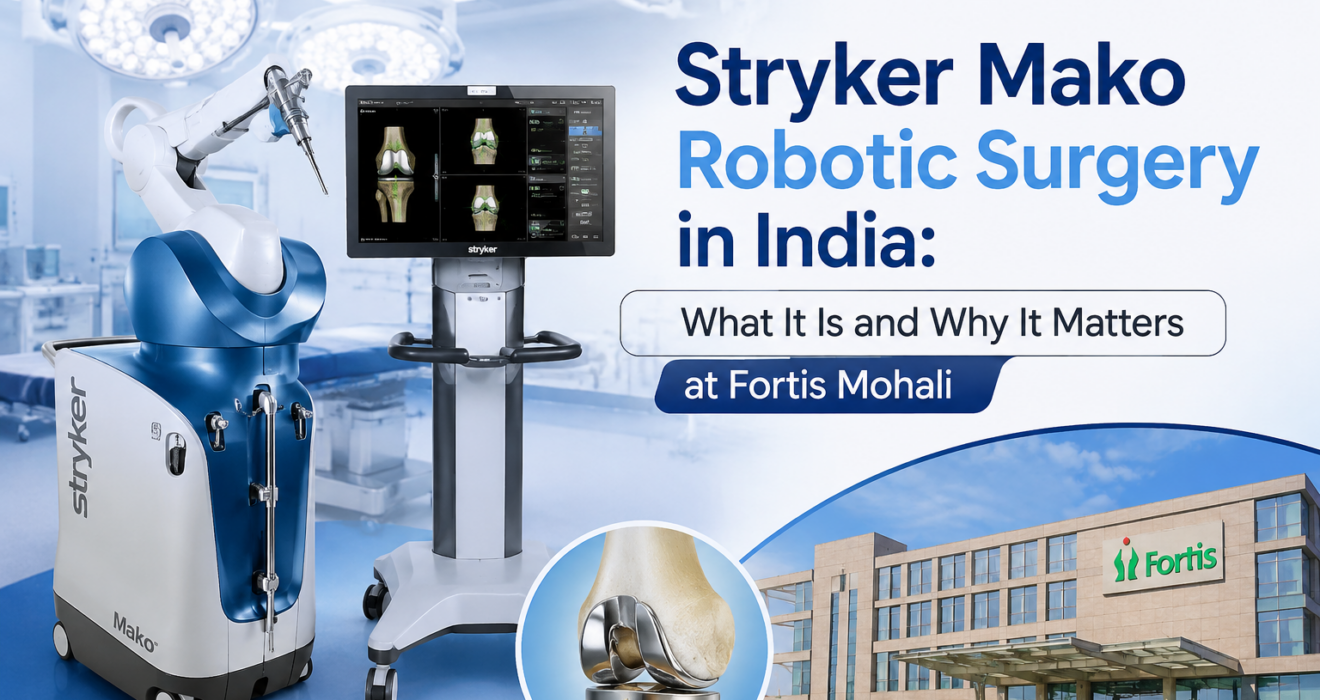
Stryker Mako Robotic Surgery in India: What It Is and Why It Matters at Fortis Mohali
The Stryker Mako robotic surgery arrived in India in earnest about six years ago. Fortis Hospital Mohali was among the early adopters in Punjab and the Chandigarh region. I’ve been using it since, and the honest assessment of its impact on my practice is this: it has made a good operation more precise and consistent. Not different in kind — in degree.
But there’s significant confusion in the public understanding of what “robotic surgery” means — most of it driven by marketing on one side and scepticism on the other. Let me explain, specifically and practically, what the Mako system does, what the data shows, and what difference it makes for a patient having hip replacement surgery at Fortis Mohali.
The Problem Mako Was Designed to Solve
Traditional hip replacement depends heavily on the surgeon’s intra-operative judgement and feel. Positioning the acetabular cup — the socket component — at the correct angle is one of the most important technical steps in the operation. An acetabular cup placed outside the “safe zone” of inclination and anteversion angles risks bearing impingement, increased risk of dislocation, and uneven load distribution that shortens implant life.
Studies on conventional hip replacement show that even in experienced hands, a meaningful percentage of cups land outside the accepted safe zone. Not by a lot — often by a few degrees — but enough to matter over 20 years and 10 million steps.
The Mako system was designed specifically to reduce this variability.
How the CT-Based Planning Works
Every Mako hip replacement begins with a CT scan of the patient’s pelvis and proximal femur, performed two to three weeks before surgery. This scan is processed by the Mako software to create a three-dimensional digital model of that specific patient’s anatomy — their pelvis tilt, their femoral offset, their femoral neck angle, the precise dimensions of the acetabulum.
I then plan the surgery on a computer workstation. I choose the specific implant sizes, position the acetabular cup digitally at my planned angles (inclination, anteversion, and lateral coverage), and position the femoral stem. The software shows me the predicted leg length change, offset change, and centre of rotation with each adjustment. I can refine the plan until I’m satisfied — before I’ve made a single incision.
This pre-operative planning step has changed my intra-operative implant sizing decision in approximately 20% of cases compared to what I would have estimated from plain X-rays alone. That’s not a small number.
What the Robotic Arm Does During Surgery
In the operating theatre, the Mako system tracks the patient’s pelvis and the surgical instruments using optical cameras and arrays of reflective markers. When I prepare the acetabulum using a reamer, the robotic arm provides haptic feedback — physical resistance — if I deviate from the planned reaming zone. The arm doesn’t stop me from operating; it creates a tactile boundary.
This haptic boundary means that the acetabular cup consistently lands within two to three degrees of the planned angle. Published accuracy data on the Mako system shows a 95th-percentile cup placement accuracy of within 2 degrees for inclination and 4 degrees for anteversion — significantly tighter than conventional technique in most comparative studies.
What the Data Shows for Patient Outcomes
Randomised controlled trial data comparing Mako-assisted to conventional hip replacement shows: improved implant positioning accuracy (consistent across studies), reduced intra-operative estimated blood loss in some studies, and equivalent short-term functional outcomes.
What hasn’t yet been shown definitively: superior long-term implant survival. The 10 and 15-year data needed to demonstrate that better positioning translates into measurably longer implant survival is accumulating but not yet complete. This is an honest limitation of the current evidence.
What I believe, based on the mechanical rationale: a cup that is consistently well-positioned will outperform a cup that is occasionally outside the safe zone. The physics of this is not in dispute.
Mako for Knee Replacement: Also Available at Fortis Mohali
The Stryker Mako system at Fortis Mohali is used for both hip replacement surgery and knee replacement surgery . For knee replacement, the system is particularly valuable where preserving the natural knee kinematics requires precise bone resection planning. The CT-based planning and intra-operative accuracy benefits apply equally to knee replacement, and the evidence base for Mako knee replacement is arguably even stronger than for hip.
A Note on Availability and Cost
Not every hip replacement centre in Punjab and Chandigarh has the Mako system. It is a significant capital investment, and its availability is concentrated in major hospital systems. At Fortis Mohali, the Mako system is operational and available for primary and revision hip and knee replacement.
The CT scan required for pre-operative planning adds a modest cost to the overall procedure. In the context of the overall procedure cost and a 20-year implant lifetime, it is not a significant addition.
CTA: The Stryker Mako system is available at Fortis Hospital Mohali. If you want to understand whether robotic-assisted surgery is the right choice for your hip or knee, come to OPD — Tuesday and Thursday. Call +91 79735 06344.